
Key Takeaways
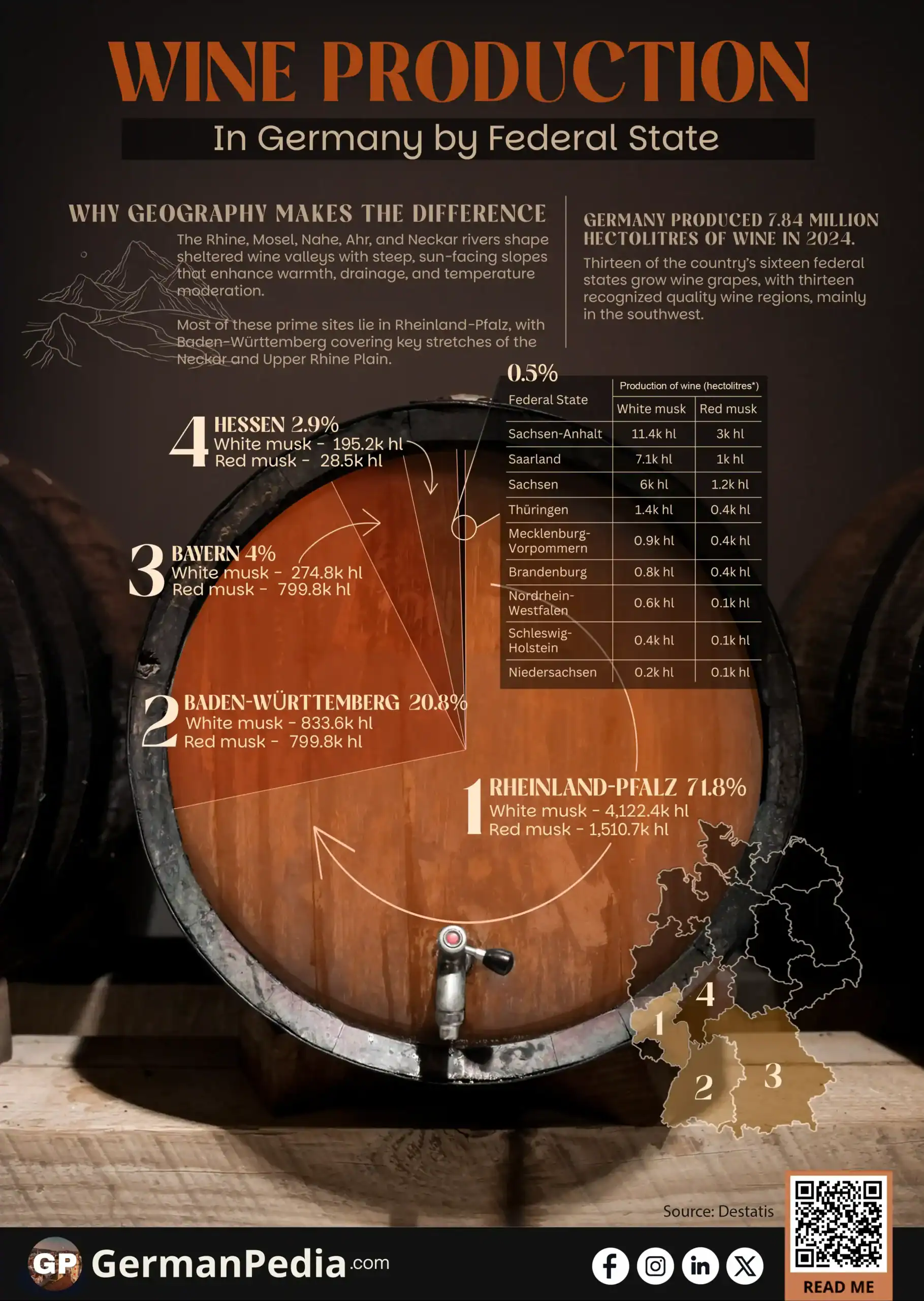
- In 2024, Germany produced about 7.84 million hectolitres of wine. 5.45 million hl were white musk and 2.39 million hl were red musk.
- Rheinland‑Pfalz alone accounts for around 5.63 million hl, or just under 72% of this national musk volume. Baden‑Württemberg followed at a distance with roughly 1.63 million hl (about 21%).
- 13 of Germany’s 16 federal states cultivate wine grapes. Aside from the two wine-making leaders, production volumes remain very small for the remaining states. However, they still contribute to regional identity.
- Wine production in Germany is concentrated in a few states due to geography and climate, which have shaped their long-standing wine-growing traditions.
Use this Visualization: You may use this image for free with proper attribution to GermanPedia (i.e., by linking back to GermanPedia).
Germany produced 7.84 million hectolitres of wine in 2024.
Thirteen of the country’s sixteen federal states cultivate wine grapes, and thirteen recognized quality wine regions are spread across them, especially in the southwestern states.
But here’s what stands out: one state produces more must than all other wine‑growing states combined.
Wine Production by Federal State
| Federal State | Wine produced (In 1,000 hectolitres*) | ||
| Total | White musk | Red musk | |
| Rheinland-Pfalz | 5,633.1 | 4,122.4 | 1,510.7 |
| Baden-Württemberg | 1,633.40 | 833.6 | 799.8 |
| Bayern | 316.7 | 274.8 | 41.9 |
| Hessen | 223.7 | 195.2 | 28.5 |
| Sachsen-Anhalt | 14.5 | 11.4 | 3.0 |
| Saarland | 8.1 | 7.1 | 1.0 |
| Sachsen | 7.2 | 6.0 | 1.2 |
| Thüringen | 1.8 | 1.4 | 0.4 |
| Mecklenburg-Vorpommern | 1.3 | 0.9 | 0.4 |
| Brandenburg | 1.2 | 0.8 | 0.4 |
| Nordrhein-Westfalen | 0.7 | 0.6 | 0.1 |
| Schleswig-Holstein | 0.4 | 0.4 | 0.1 |
| Niedersachsen | 0.3 | 0.2 | 0.1 |
| Total | 7,842.3 | 5,454.8 | 2,387.5 |
Source: Destatis
*1 hectolitre is equivalent to 100 litres

One State Uncorks Most of Germany’s Wine
Rheinland-Pfalz doesn’t just lead Germany’s wine production. It dominates it.
- Rheinland-Pfalz: 5.63 million hl (72%)
- All other wine-growing states: 2.21 million hl (28%)
Simply put, seven out of every ten bottles of German wine come from Rheinland-Pfalz.
Baden-Württemberg takes second place with about 1.63 million hl, but still less than one-third of Rheinland-Pfalz’s output. Together, these two states account for roughly 93% of Germany’s wine production.
Beyond these wine-making leaders, Bayern produces about 316,700 hl and Hessen around 223,700 hl, while the nine other wine‑growing states contribute even smaller volumes.
Nevertheless, these smaller regions remain important. They add stylistic diversity and regional character to German wine and play a meaningful role in local tourism and cultural identity.
Why Geography Makes the Difference in Wine Production
Germany sits at the northern edge of Europe’s wine-growing territory, where vines need very specific conditions to thrive. Not every landscape can provide them.
River valleys create the ideal conditions
The Rhine, Mosel, Nahe, Ahr, and Neckar rivers do more than flow through wine country. They form sheltered corridors with steep, often south‑facing slopes that capture solar radiation, promote good drainage, and moderate temperature extremes.
Rheinland-Pfalz holds most of these prime valleys, while Baden-Württemberg includes key sections of the Neckar and the Upper Rhine Plain.
Climate at the cool margin
Germany lies in a relatively cool wine‑growing zone, so vineyards need warm, sheltered sites to ripen grapes reliably.
Classic regions along the Rhine and its tributaries offer these conditions, while many northern and eastern areas lack similarly large, climatically favoured vineyard zones.
History reinforced the pattern
Winegrowing in regions such as the Mosel, Rhine and Palatinate goes back to Roman and medieval times. Over centuries, these areas developed extensive terraced vineyards, cellar facilities, trade networks, and specialized expertise.
This long history concentrated investment, cooperatives, and larger wineries in the southwestern wine regions, reinforcing their role as the core of German wine production.
Overall, viticulture in Germany concentrates where conditions favour it most: cool‑climate sites with sufficient warmth, exposure and suitable soils. The wine industry identified these optimal locations centuries ago, built infrastructure around them, and, as a result, production remains focused there today.
More topics
- Highest Paying Jobs in Germany
- Popular Study Destinations for German Students
- Educational Attainment in European Countries
- Grocery Prices in Germany Have Increased Since 2000
- Germany’s Smoking Rate Has Declined Over Two Decades
- Germany’s Electricity Mix: From Coal to Renewables
- Changes in Harvest of Germany’s Five Key Crops
- Top German Companies by Revenue
- Germany’s Top Car Brands by New Registrations
- Unemployment Across Germany: A Federal State Breakdown
- Where Germany’s Tourists Come From
- Germany’s Largest National Parks, Ranked by Size
- Which Federal States Drive Germany’s Economy?
- How Marriage Rates Have Fallen in Germany: 1990–2023
- Leading Causes of Death in Germany