Key Takeaways
- Since December 2025, the first fuel price spike in early January came mainly from Germany’s CO₂ pricing adjustment, not from conflict.
- Markets reacted only when supply was at risk. Fuel prices stayed stable through early February despite rising tensions, as oil supply remained unaffected.
- The biggest weekly jump occurred around March 9, 2026, after risks to oil flows through the Strait of Hormuz increased.
- Germany’s fuel prices were higher than the EU average. They rose more sharply too. Global oil shocks hit German consumers harder because Germany’s taxes and fuel costs are higher than in many other EU countries.
- Different fuels react differently to the same shock. Diesel moved the most because it’s used more widely across industries.
Use this Visualization: You may use this image for free with proper attribution to GermanPedia (i.e., by linking back to GermanPedia).
Need help communicating complex ideas visually? We help you turn data into your most persuasive story. Contact us to learn more.
Germany Weekly Fuel Prices
| Date | Euro 95 | Diesel | Heating Oil | LPG |
|---|---|---|---|---|
| In €/L (weekly change) | ||||
| Mar 30, 2026 | 2.13 (0.00) | 2.29 (-0.01) | 1.23 (+0.01) | 1.04 (-0.04) |
| Mar 23, 2026 | 2.13 (+0.05) | 2.30 (+0.15) | 1.24 (+0.03) | 1.08 (+0.01) |
| Mar 16, 2026 | 2.09 (+0.01) | 2.15 (-0.02) | 1.21 (+0.02) | 1.07 (-0.01) |
| Mar 9, 2026 | 2.08 (+0.19) | 2.16 (+0.35) | 1.18 (+0.19) | 1.08 (+0.04) |
| Mar 2, 2026 | 1.89 (+0.06) | 1.81 (+0.08) | 0.99 (+0.03) | 1.04 (-0.01) |
| Feb 23, 2026 | 1.82 (+0.02) | 1.73 (+0.02) | 0.96 (+0.03) | 1.05 (-0.01) |
| Feb 16, 2026 | 1.81 (+0.01) | 1.71 (0.00) | 0.93 (-0.03) | 1.04 (-0.01) |
| Feb 9, 2026 | 1.80 (+0.00) | 1.71 (-0.01) | 0.96 (+0.01) | 1.05 (-0.01) |
| Feb 2, 2026 | 1.80 (+0.01) | 1.72 (+0.03) | 0.95 (+0.02) | 1.04 (-0.01) |
| Jan 26, 2026 | 1.79 (0.00) | 1.70 (+0.00) | 0.93 (0.00) | 1.05 (+0.01) |
| Jan 19, 2026 | 1.79 (+0.00) | 1.69 (+0.01) | 0.93 (+0.03) | 1.04 (+0.02) |
| Jan 12, 2026 | 1.79 (+0.01) | 1.68 (+0.01) | 0.91 (-0.02) | 1.02 (-0.01) |
| Jan 5, 2026 | 1.78 (+0.08) | 1.68 (+0.08) | 0.93 (+0.02) | 1.04 (+0.01) |
| Dec 29, 2025 | 1.70 (+0.01) | 1.59 (+0.01) | 0.91 (0.00) | 1.04 (+0.01) |
| Dec 22, 2025 | 1.69 (-0.01) | 1.58 (-0.01) | 0.91 (-0.02) | 1.02 (-0.00) |
| Dec 15, 2025 | 1.70 (-0.02) | 1.59 (-0.02) | 0.93 (+0.01) | 1.02 (+0.00) |
| Dec 8, 2025 | 1.71 (-0.01) | 1.61 (-0.02) | 0.92 (-0.03) | 1.02 (-0.00) |
| Dec 1, 2025 | 1.73 | 1.63 | 0.95 | 1.02 |
Source: European Commission

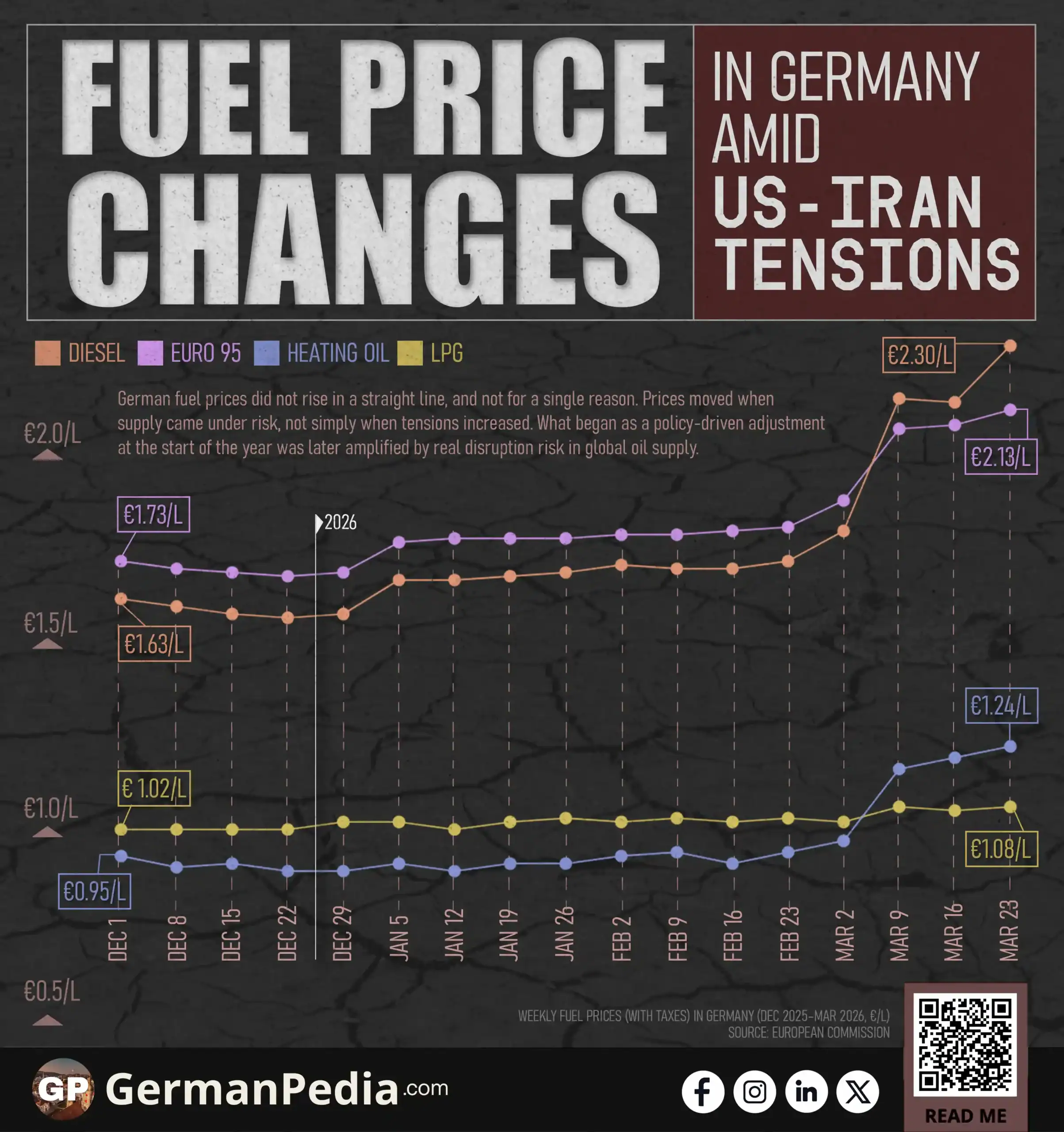
At the beginning of December 2025, fuel prices in Germany were stable.
Petrol sat around €1.73 per litre. Diesel was near €1.63. Heating oil was just under €0.95. These figures are based on weekly averages. They reflect price levels over several days rather than a single point in time.
By December 8, 2025, prices declined across most fuels.
This is an important baseline. Even amid ongoing global geopolitical tensions, consumer fuel prices did not react. Markets were still operating under normal expectations.
On January 5, 2026, prices recorded the first clear spike:
- Petrol: +€0.08 per litre
- Diesel: +€0.08 per litre
- Smaller increases in heating oil and LPG
This was the first broad upward movement since December.
However, this increase was not linked to geopolitical events. Instead, it’s a policy-driven one.
At the start of the year, Germany adjusted its CO₂ pricing on fuels, which raised petrol and diesel costs. Crude oil prices also edged slightly higher. Petrol averaged around €1.70 per litre, still close to late-2025 levels.
In the weeks after January 5, prices briefly stabilized before the US-Iran war escalated. At that time:
- The United States expanded its military presence
- Iran conducted drills near the Strait of Hormuz
Yet prices stayed steady. This shows how markets respond more to actual supply risk than to political tension alone. As long as oil continued to flow normally, prices remained stable.
The situation changed in the week of February 28, 2026.
The United States and Israel launched airstrikes on Iran. In response, Iran warned that shipping through the Strait of Hormuz could be disrupted, which is a key route for global oil supply.
This marked a turning point in the market. Before then, oil had continued flowing normally despite rising tension. After the strikes, the risk shifted toward possible delays and disruptions in shipments, and prices began to move higher.
Oil markets respond to expected supply, not just current flows. This became visible in the data.
From late February into early March, German fuel prices rose each week across petrol, diesel, and heating oil. The increase was gradual rather than sudden. Fuel prices started increasing even before supplies were disrupted because markets expected shortages. During this period, shipping costs and war-risk insurance rose sharply, and global oil markets moved up quickly.
The biggest weekly jump appeared on March 9, 2026:
- Petrol: +€0.19 per litre
- Diesel: +€0.35 per litre
- Heating oil: +€0.19 per litre
During this period:
- oil flows through the Strait of Hormuz became uncertain
- shipping and insurance costs rose sharply
- global oil prices reacted quickly
Germany’s increases were also steeper than the EU average. EU petrol prices rose from about €1.66 to €1.77 per litre for the weeks of March 2 and March 9, an increase of 0.11. In Germany, petrol rose from 1.89 to 2.08 over the same period, a larger increase of 0.19. The difference was even more pronounced for diesel.
This is partly because Germany has higher energy taxes and CO2-related charges than many other EU countries, so global oil price increases pass through more strongly to consumers.
It is also important to note that this spike did not happen in isolation. German fuel prices had already been rising in the days and weeks before March 9, as markets gradually priced in the growing risk of disruption.
By March 16, 2026, the pace of the surge had eased. Petrol was nearly flat, diesel slipped slightly, and LPG edged down.
Prices were still high, but the pace of change had started to cool. This suggests the market had already absorbed much of the initial shock. Even as the conflict continued, much of the uncertainty was already reflected in prices.
The data also shows clear differences between fuels:
- Diesel rose the most because it is deeply tied to transport and logistics. Trucks, freight companies, farms, and many industries rely on diesel, so when supply risk rises, demand can stay strong, and prices can move up quickly.
- Diesel’s supply chain is also more vulnerable to disruptions. If refining, imports, or shipping are affected, prices can rise quickly as supplies become tighter.
- Heating oil also increased strongly. Winter demand was already high, so supply disruptions had a bigger impact on prices.
- Petrol rose more gradually. It still reacts to global oil costs, but it often adjusts more slowly when a shock is still building, as stations spread price changes over time.
- LPG changed very little. It is used in fewer households and vehicles, so short-term shocks may affect it less directly.
Overall, this shows that different fuels do not react in the same way. Their market role, demand pattern, and supply chain all affect how fast prices change.
German fuel prices did not rise in a straight line, and not for a single reason. Fuel prices rose when oil supplies were at risk, not simply because political tensions increased. What began as a policy-driven adjustment at the start of the year was later amplified by the real risk of disruption to global oil supply.
More topics
- Most Visited AI Websites in Germany
- Claude Usage in the EU: Which Countries Lead and Why?
- EU Alternatives to Common US Platforms
- Top 13 Most Valuable Brands in the EU
- Top 20 Most Visited Websites in Germany
- Which Countries Use AI the Most in the EU?
- Germany’s Average Working Age Is Getting Older
- Germany’s Top 8 Most Valuable Brands
- EU Unicorn Startups: Which Countries Lead and Why
- GDP of European Countries
- Ukraine War Casualties Reach 1.8 Million After Four Years
- Air Defence Systems Drive Advanced Weapons Support to Ukraine
- Heavy Armour Support to Ukraine is Led by a Few Countries
- EU Military Manpower Changed Since 2020
- Employment in the EU Is Shifting Toward Higher Education
- Women Are Increasing in Managerial Roles Across the EU
- Bilateral Support to Ukraine Reached €342 Billion
References
- https://energy.ec.europa.eu/data-and-analysis/weekly-oil-bulletin_en
- https://www.euronews.com/business/2026/03/18/why-is-petrol-more-expensive-in-germany-than-most-places-in-the-eu
- https://www.newsworm.de/news/germany-fuel-prices-surge-in-2026-amid-higher-co2-costs#google_vignette
- https://www.aljazeera.com/news/2026/2/22/iran-us-tensions-what-would-blocking-strait-of-hormuz-mean-for-oil-lng
- https://www.cfr.org/global-conflict-tracker/conflict/confrontation-between-united-states-and-iran
- https://www.eia.gov/energyexplained/diesel-fuel/factors-affecting-diesel-prices.php