
Key Takeaways
- Foreign-born populations are rising across most of the EU. By 2025, 46.7 million people (10.4%) in the EU were born abroad.
- In 2025, large countries like Germany (17.2 mil.), France (9.6 mil.), and Spain (9.5 mil.) had the highest increase in the foreign-born population in terms of absolute numbers.
- Luxembourg (51.5%) and Malta (32.0%) have the highest share of foreign-born residents, which is amplified by their small populations.
- Migration in the EU is shaped by a mix of economic, demographic, and policy factors. Ageing populations and labour-market demand are among the key drivers, creating gaps that are increasingly filled by people born abroad.
- Greece (11.8% → 11.0%) and Latvia (15.0% → 11.6%) are the only EU countries that faced a decline in the share of foreign-born residents.
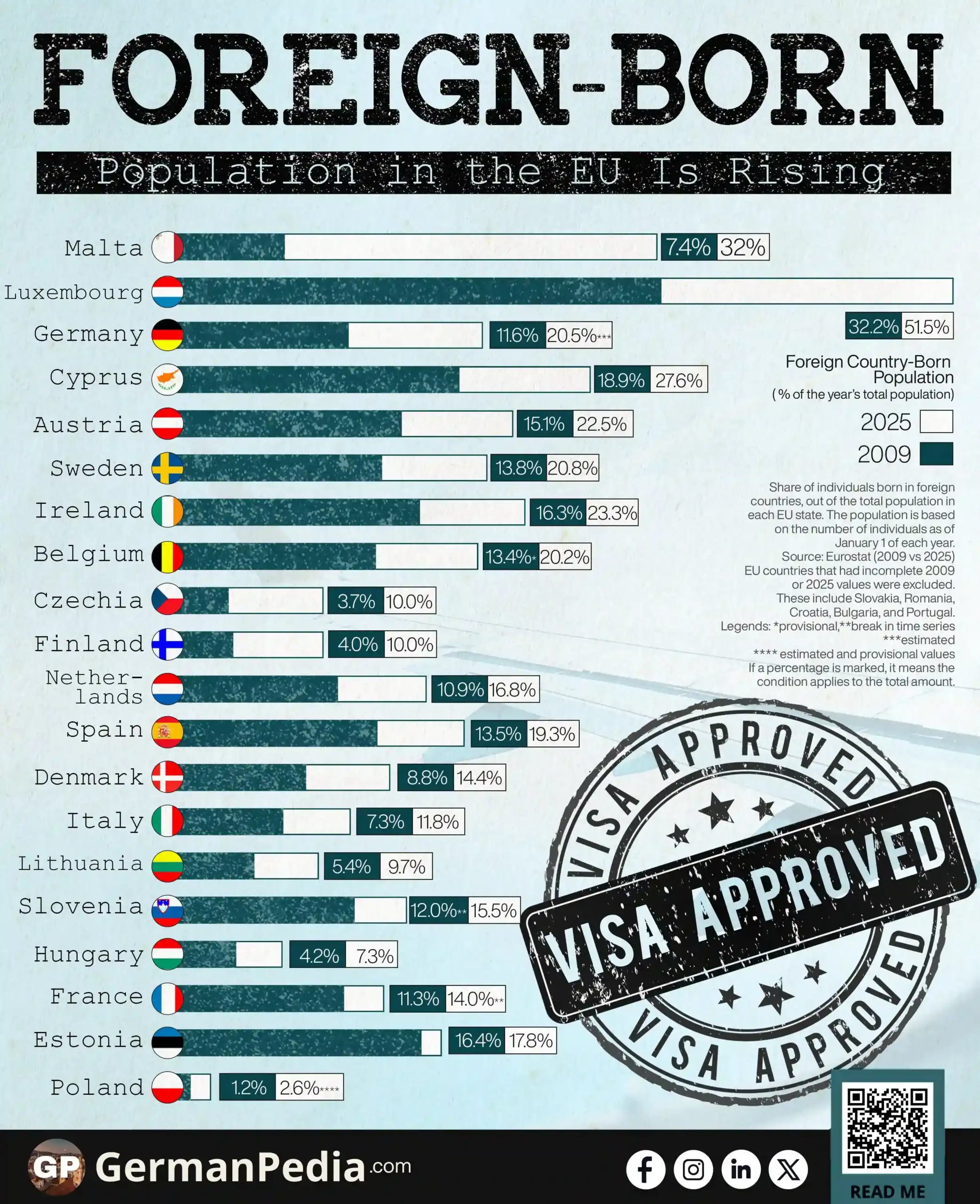
Use this Visualization: You may use this image for free with proper attribution to GermanPedia (i.e., by linking back to GermanPedia).
Need help communicating complex ideas visually? We help you turn data into your most persuasive story. Contact us to learn more.
EU Countries’ Foreign-Born Population Over Time
| Reporting Country | Foreign Country-Born Population (In thousands, % of the year’s total population) | Change in p.p. | |
|---|---|---|---|
| 2009 | 2025 | ||
| Malta | 30.5 (7.4%) | 183.8 (32.0%) | +24.6 |
| Luxembourg | 159.0 (32.2%) | 351.4 (51.5%) | +19.3 |
| Germany | 9,548.9 (11.6%) | 17,153.5*** (20.5%) | +8.9 |
| Cyprus | 150.8 (18.9%) | 270.8 (27.6%) | +8.7 |
| Austria | 1,259.6 (15.1%) | 2,069.4 (22.5%) | +7.4 |
| Sweden | 1,280.9 (13.8%) | 2,199.0 (20.8%) | +7.0 |
| Ireland | 735.5 (16.3%) | 1,267.1 (23.3%) | +7.0 |
| Belgium | 1,443.9* (13.4%*) | 2,399.6 (20.2%) | +6.8 |
| Czechia | 384.2 (3.7%) | 1,095.6 (10.0%) | +6.3 |
| Finland | 214.1 (4.0%) | 566.1 (10.0%) | +6.0 |
| Netherlands | 1,793.7 (10.9%) | 3,025.7 (16.8%) | +5.9 |
| Spain | 6,225.5 (13.5%) | 9,464.2 (19.3%) | +5.8 |
| Denmark | 486.0 (8.8%) | 862.1 (14.4%) | +5.6 |
| Italy | 4,358.8 (7.3%) | 6,928.0 (11.8%) | +4.5 |
| Lithuania | 171.2 (5.4%) | 281.0 (9.7%) | +4.3 |
| Slovenia | 243.4** (12.0%**) | 329.5 (15.5%) | +3.5 |
| Hungary | 424.0 (4.2%) | 693.2 (7.3%) | +3.1 |
| France | 7,245.6 (11.3%) | 9,633.7** (14.0%**) | +2.7 |
| Estonia | 220.3 (16.4%) | 243.3 (17.8%) | +1.4 |
| Poland | 453.2 (1.2%) | 940.3**** (2.6%) | +1.4 |
| Greece | 1,304.7 (11.8%**) | 1,142.2 (11.0%) | −0.8 |
| Latvia | 324.9 (15.0%) | 215.6 (11.6%) | −3.4 |
Source: Eurostat (2009 vs 2025)
EU countries that had incomplete 2009 or 2025 values were excluded. These include Slovakia, Romania, Croatia, Bulgaria, and Portugal.
*provisional
**break in time series
***estimated
**** estimated and provisional values
If a percentage is marked, it means the condition applies to the total amount.

Migration in the European Union is shaped by a mix of economic, demographic, and policy factors. These include labour demand, education, and family reunification.
At the same time, EU policy has increasingly encouraged legal migration to help address labour shortages and support economic growth, contributing to a gradual rise in the foreign-born population.
On January 1, 2025, 46.7 million people living in the EU were born in foreign countries. This makes up 10.4% of the total EU population.
Recent population trends have been moving in this direction for various reasons, which include:
- continued immigration from outside the EU
- mobility within the EU
- slower growth of the native-born population
Together, these factors have steadily increased the share of residents over time.
Two countries hold the highest shares of foreign-born residents in their total population:
- Malta: 7.4% → 32.0% (+24.6 pp)
- Luxembourg: 32.2% → 51.5% (+19.3 pp)
In Luxembourg, the labour market is deeply integrated with neighbouring countries through extensive cross-border commuting. Its foreign-born residents were already close to half the population in 2020 and became a majority later on, making migration a structural feature of the economy and society.
In Malta, the shift is closely linked to Maltese workers moving into office-based jobs, leaving strong labor demand in tourism and other service-oriented sectors, which is increasingly filled by foreign workers.
In both cases, the countries’ sizes also matter. As small countries, even moderate increases in people moving in can lead to large changes in percentages.
In larger countries, percentage increases are less extreme, but the number of foreign-born residents is much higher in absolute terms.
- Germany: 9.5 mil. → 17.2 mil. (11.6% → 20.5%)
- Spain: 6.2 mil. → 9.5 mil. (13.5% → 19.3%)
- France: 7.2 mil. → 9.5 mil. (11.3% → 14.0%)
These figures are far above those of smaller countries such as Luxembourg, with more than 351,000 foreign-born residents in 2025, even though it has a much higher share of foreign-born residents (51.5%).
In these larger economies, migration appears closely linked to ageing populations and labour-market needs. In Germany, an ageing society is already contributing to labour shortages in several occupations. Meanwhile, in France and Spain, foreign workers are increasingly used to fill gaps in sectors facing recruitment difficulties and labour scarcity.
What is the median age in each EU country? ->
There are also a few countries that move in the opposite direction:
- Greece: 11.8% → 11.0%
- Latvia: 15.0% → 11.6%
In Latvia, long-term demographic pressures (e.g., sustained emigration, low fertility, aging population) appear to outweigh gains in the foreign-born population.
In Greece, the decline likely reflects the impact of economic shocks, particularly following the European debt crisis, alongside changes in migration patterns.
Across the EU, the foreign-born population has increased overall, but at very different speeds. This uneven pattern reflects how migration interacts with each country’s labour market, demographics, and population size.
More topics
- Happiness vs Income in the EU
- Which Countries Use AI the Most in the EU?
- Electric and Hybrid Cars in the EU: Who Is Leading the Shift?
- Claude Usage in the EU: Which Countries Lead and Why?
- Petrol Prices Are Rising Across the EU
- Top 13 Most Valuable Brands in the EU
- Germany’s Average Working Age Is Getting Older
- EU Countries with the Most U.S. Troops
- Where are Billionaires Concentrated in the EU?
- Employment by Federal State in Germany
- Germany’s Median Wage by Federal State
- Italy is the Old Man of Europe
- Which Federal States Drive Germany’s Economy?
- EU Unicorn Startups: Which Countries Lead and Why
- Top 10 Richest Women in the EU
- EU Alternatives to Common US Platforms
- Top EU Countries Where People Say They Don’t Need AI
References
- https://ec.europa.eu/eurostat/databrowser/view/migr_pop3ctb__custom_19852226/default/table
- https://ec.europa.eu/eurostat/statistics-explained/index.php?title=EU_population_diversity_by_citizenship_and_country_of_birth
- https://www.europarl.europa.eu/topics/en/article/20200624STO81906/exploring-migration-causes-why-people-migrate
- https://immigrantinvest.com/reports/eu-migration-statistics/
- https://timesofmalta.com/article/how-foreign-workers-driving-maltese-industries.1081028
- https://www.researchluxembourg.org/en/luxembourg-becomes-the-first-oecd-country-with-a-majority-foreign-born-population/
- https://www.cedefop.europa.eu/files/EUSP_AH_Luxembourg_0.pdf
- https://www.cedefop.europa.eu/en/data-insights/spain-mismatch-priority-occupations
- https://www.lemonde.fr/en/opinion/article/2023/06/08/resorting-to-labor-immigration-is-inevitable_6030530_23.html
- https://bsi-economics.org/labor-shortages-in-france-a-situation-that-masks-structural-trends/
- https://www.visahq.com/news/2026-01-22/es/spain-posts-record-312-million-foreign-workers-as-talent-shortages-persist/