Key Takeaways
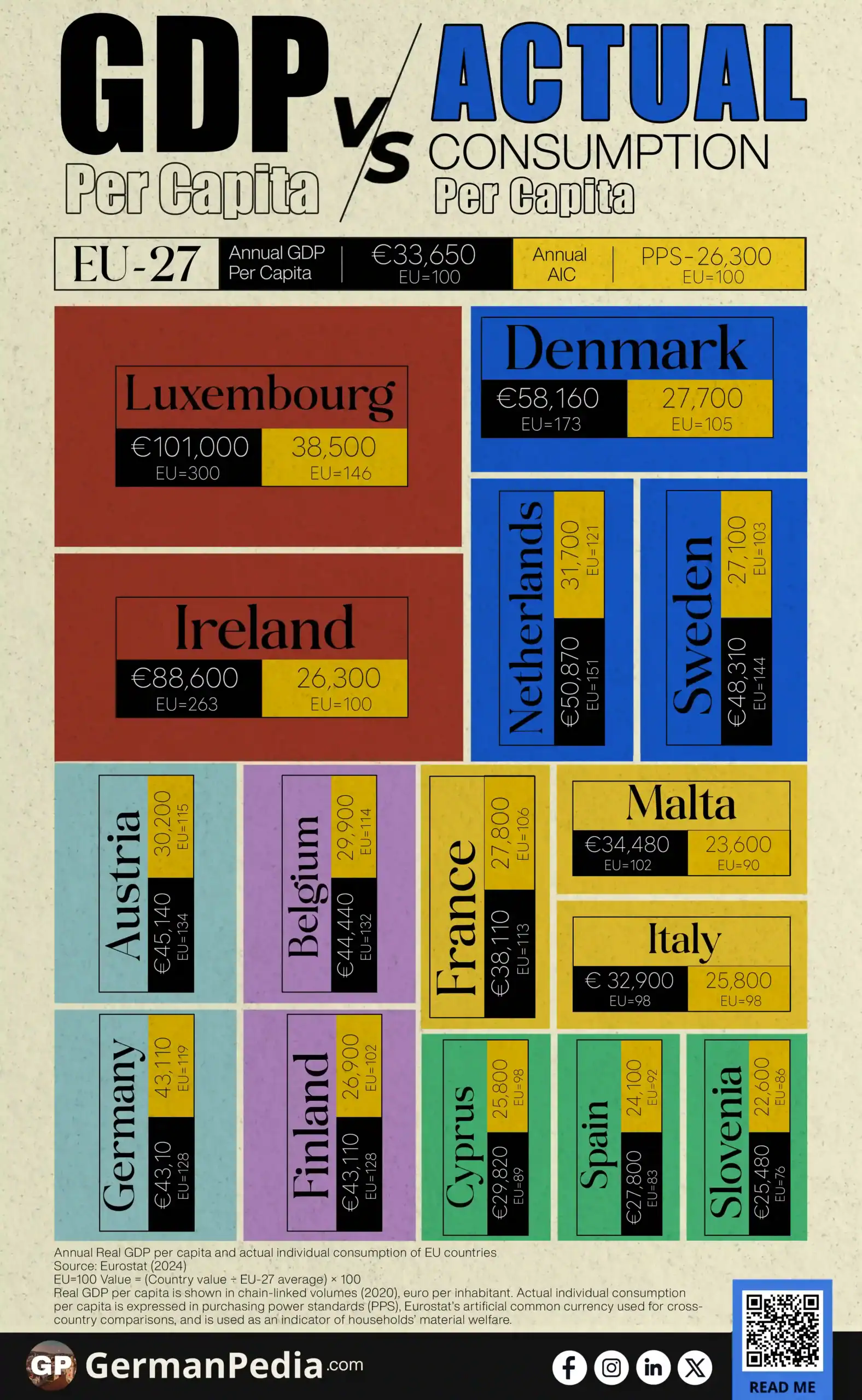
- Luxembourg ranks first in the EU on both output and consumption, but not by the same margin. GDP per capita (€101,000) is inflated by cross-border workers, while consumption (38,500 PPS) is much less extreme.
- Ireland’s GDP per capita makes it look richer than what households there actually experience. That is because large global companies book profits in Ireland that never reach Irish households.
- Germany shows a closer link between what it produces and what people consume. With GDP at 128 and AIC at 119 (EU average = 100), a strong home-grown economy supports household spending directly.
- Poland and Romania outperform their GDP rankings in consumption. Lower price levels and EU economic convergence make their incomes go much further, narrowing consumption gaps.
- Some countries remain below average even after adjustment. Bulgaria and Hungary lag due to lower productivity and wages.
- GDP gaps between EU countries are bigger than consumption gaps. The EU looks less unequal once you look at what people actually get to use, rather than what their economies produce.
Use this Visualization: You may use this image for free with proper attribution to GermanPedia (i.e., by linking back to GermanPedia).
Need help communicating complex ideas visually? We help you turn data into your most persuasive story. Contact us to learn more.
GDP per capita shows how much a country produces for every person living there, on average. It shows what gets produced or the total value of everything a country makes and sells in a year. It does not show what people actually get to use in their daily lives.
Actual Individual Consumption, or AIC, fills that gap. It measures what people really consume:
- Goods they buy
- Services they receive
- Government-provided items like healthcare and education
AIC leaves out government spending that benefits everyone in general, like national defense, since no one consumes that individually.
So a useful way to think about it is:
- GDP per capita → what the country produces per person
- AIC per capita → what each person actually gets to use
Together, they give a fuller picture of living standards than either number alone.
EU Countries’ GDP and Actual Individual Consumption per Capita
| Country | Annual GDP Per Capita | Annual AIC | ||
|---|---|---|---|---|
| € per capita | EU=100 | PPS | EU=100 | |
| EU-27 | 33,650 | 100 | 26,300 | 100 |
| Luxembourg | 101,000 | 300 | 38,500 | 146 |
| Ireland | 88,600 | 263 | 26,300 | 100 |
| Denmark | 58,160 | 173 | 27,700 | 105 |
| Netherlands | 50,870 | 151 | 31,700 | 121 |
| Sweden | 48,310 | 144 | 27,100 | 103 |
| Austria | 45,140 | 134 | 30,200 | 115 |
| Belgium | 44,440 | 132 | 29,900 | 114 |
| Germany | 43,110 | 128 | 31,400 | 119 |
| Finland | 43,110 | 128 | 26,900 | 102 |
| France | 38,110 | 113 | 27,800 | 106 |
| Malta | 34,480 | 102 | 23,600 | 90 |
| Italy | 32,900 | 98 | 25,800 | 98 |
| Cyprus | 29,820 | 89 | 25,800 | 98 |
| Spain | 27,800 | 83 | 24,100 | 92 |
| Slovenia | 25,480 | 76 | 22,600 | 86 |
| Portugal | 22,370 | 66 | 22,600 | 86 |
| Czechia | 21,920 | 65 | 21,500 | 82 |
| Estonia | 21,060 | 63 | 19,600 | 75 |
| Lithuania | 19,690 | 59 | 23,200 | 88 |
| Slovakia | 19,110 | 57 | 20,400 | 78 |
| Greece | 19,020 | 57 | 20,900 | 80 |
| Croatia | 17,060 | 51 | 20,800 | 79 |
| Latvia | 16,910 | 50 | 19,000 | 72 |
| Poland | 16,470 | 49 | 22,300 | 85 |
| Hungary | 16,210 | 48 | 19,100 | 73 |
| Romania | 13,090 | 39 | 22,600 | 86 |
| Bulgaria | 11,330 | 34 | 19,200 | 73 |
Source: Eurostat (2024)
EU=100 shows how a country compares to the EU average: (that country’s value ÷ EU-27 average) × 100. A score of 100 means exactly average. Above 100 means above average. Below 100 means below average.
Real GDP per capita is shown in chain-linked volumes (2020), in euros per person. “Chain-linked” means the euro figures are adjusted to remove the effect of inflation over time, using 2020 as the reference year. These euro figures are not adjusted for the fact that prices differ from country to country.
Actual individual consumption per capita is shown in purchasing power standards (PPS), an artificial currency Eurostat created so that 1 PPS buys the same basket of goods and services in every country. PPS corrects for price differences between countries. Euro figures do not. It is also used as an indicator of households’ material welfare.

Luxembourg and Ireland stand out at the top of the list, but they tell very different stories.
Luxembourg is the only country that sits firmly at the top in both output and consumption. However, the gap between those two numbers is important.
- GDP per capita: €101,000
- AIC per capita: 38,500 PPS
Its GDP per capita is extremely high, while consumption is also high but much less extreme.
Many people who work in Luxembourg are cross-border workers. They live across the border in neighboring countries and commute in each day. Their work counts toward Luxembourg’s GDP, since GDP counts economic activity that happens inside a country’s borders. But much of what they earn gets spent back home, not in Luxembourg. That pulls Luxembourg’s AIC further away from its GDP.
Luxembourg also has a large banking and financial services sector. It adds a lot of value to what the country produces without adding as much to what its residents consume.
Ireland shows a different way GDP and consumption can pull apart.
- GDP per capita: €88,600
- AIC per capita: 26,300 PPS (EU average = 100)
Ireland’s GDP per capita puts it among the richest countries in Europe. Its actual consumption, though, sits right at the EU average.
Many large global companies base their European operations in Ireland. They record big profits there, along with the value of patents, brands, and other intellectual property, mainly for tax reasons. That inflates Ireland’s GDP, but most of that money never reaches Irish households or gets spent inside Ireland.
Patent Applications In The EU Are Rising ->
After these two outliers, most EU countries show a closer link between GDP per capita and actual consumption.
Germany’s GDP per capita (EU average = 128) and AIC per capita (EU average = 119) both sit comfortably above average, without a big gap between them.
Most of what Germany produces and spends happens within its own borders, not through foreign companies or commuting workers. That means Germany’s output more directly supports what German households can actually consume.
Germany’s GDP Growth Over Time ->
Further down the ranking, some countries sit much lower on GDP but much closer to the EU average on consumption. This includes:
- Poland (€16,470 GDP per capita | 22,300 PPS AIC)
- Romania (€13,090 | 22,600 PPS)
Two things explain this:
- Lower price levels mean income buys more. Poland (EU Ave. = 72) and Romania (EU Ave. = 64) have significantly cheaper goods and services.
- Economic convergence within the EU. Both countries have seen rapid gains in incomes and consumption over the past decade.
AIC gaps are smaller than GDP gaps because PPS corrects for price differences between countries, while the euro figures used for GDP do not. Even with a lower GDP, people in Poland and Romania can consume almost as much as the EU average, because their money simply goes further.
At the lower end, some countries stay below the EU average on both measures:
- Bulgaria (€11,330 GDP per capita | 19,200 PPS AIC)
- Hungary (€16,210 | 19,100 PPS)
- Greece (€19,020 | 20,900 PPS)
Bulgaria, Hungary, and Greece all have lower productivity. That means each worker produces less economic value on average. They also have lower wages and a larger share of jobs in industries that pay less (e.g., basic agriculture, manufacturing), compared with higher-paying sectors (e.g., finance, advanced manufacturing). Together, this limits both what these economies produce and what their households can afford to consume.
Three factors explain most of the patterns across EU countries:
- Where economic activity is recorded (multinationals in Ireland, financial hubs in Luxembourg)
- Who is counted in the population (Luxembourg’s cross-border workforce)
- How far income goes (lower prices in Poland and Romania)
GDP per capita shows large gaps between EU countries. Actual consumption shows much smaller ones. Price levels, how an economy is structured, and how output actually reaches households all shape the difference. The EU looks less unequal once you measure what people actually get to consume, rather than what their economies produce.
More topics
- GDP of European Countries
- Top 10 Biggest EU Companies Led by Women
- Top 13 Most Valuable Brands in the EU
- Where are Billionaires Concentrated in the EU?
- Employment by Federal State in Germany
- Germany’s Median Wage by Federal State
- Germany’s Top 8 Most Valuable Brands
- Which Federal States Drive Germany’s Economy?
- EU Unicorn Startups: Which Countries Lead and Why
- Employment in the EU Is Shifting Toward Higher Education
- Women Are Increasing in Managerial Roles Across the EU
- Top 10 Richest Women in the EU
- EU Alternatives to Common US Platforms
- Which Countries Use AI the Most in the EU?
- Top EU Countries Where People Say They Don’t Need AI
- Happiness vs Income in the EU
References
- https://ec.europa.eu/eurostat/databrowser/view/sdg_08_10/default/table?lang=en
- https://ec.europa.eu/eurostat/databrowser/view/prc_ppp_ind_1__custom_20885752/default/table
- https://ec.europa.eu/eurostat/web/products-eurostat-news/-/ddn-20211215-1
- https://www.ecb.europa.eu/press/economic-bulletin/focus/2023/html/ecb.ebbox202303_02~3404c284d0.en.html
- https://ec.europa.eu/eurostat/statistics-explained/index.php?
- https://www.thediplomat.ro/2025/09/11/romanias-economic-convergence-in-the-european-context-theoretical-considerations-and-empirical-evidence/